Wednesday, May 4th
Passing through Iowa & Illinois
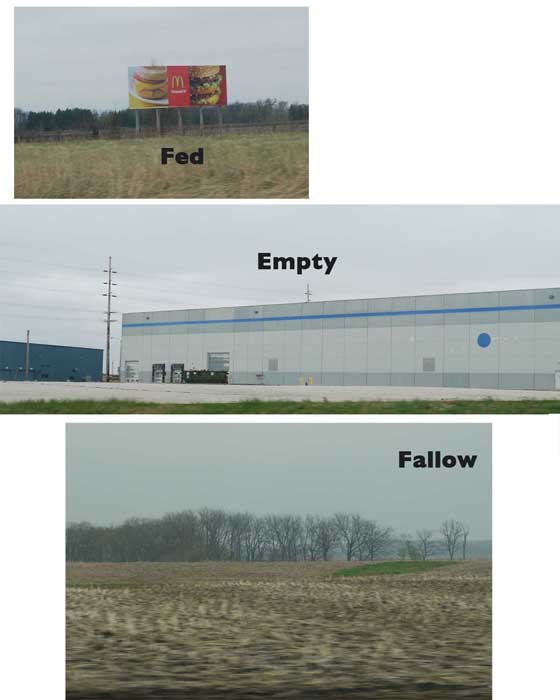
05.04.11 @ 09:56PST
Monday, May 2nd
Missed the bus, but hear the news.
I dream that I am left behind, on a field trip.
I am looking for the rain cover for a video camera. I can not find it.
There is no written schedule, just a woman who herds us and tells us we must get on the bus, or some large SUV like wagon. I am not sure of what is going on or why in fact I am there.
Wake up, hot, under covers between an outstretched cat and a husband radiating warmth. It is 3:25 am.
Last night he came home from the video store, empty handed because they did not have the correct episode of the Sopranos and told me he heard on the radio that "they got Osama bin Laden."
Within days of Prince William and Kate's royal wedding?
Immediately, I wonder what does it mean? How does this act bring peace and stability? Does it stop terrorism? How much power did Osama bin Laden have in hiding? I look for news and reactions on the Internet. First hit: fans at a Phillies game cheer Osama's death.
Can evil or bad acts be cured? Couldn't this also fan terrorism or other acts of violence like blowing on embers? I read Obama and staff have been in the situation room a lot in the days leading to the raid that killed Osama. Win a peace prize and encourage assassination? It is good to get rid of bad, but I get images of Westerns with cowboys and Indians and 8th graders making videos with fingers in the place of guns, as I work with them under funding to stop violence and bullying.
Am I not a good player, a good teammate because I am too puzzled to cheer?
05.02.11 @ 14:30PST
Thursday, January 13th
Solstice Collage
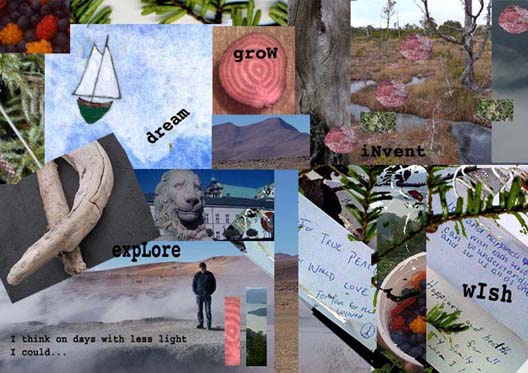
01.13.11 @ 17:48PST
What I saw on my walk #1
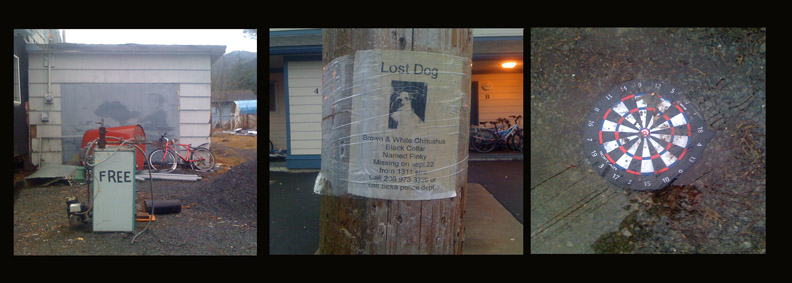
01.13.11 @ 17:37PST
Friday, August 24th
Belly of the Beast
My head is full of images of old growth trees with ferns and skunk cabbages growing by their trunks, degraded roads and clear cuts along with the words of people we interviewed in the last days in Ketchikan and Prince of Wales, communities south of Sitka. "We're in the belly of the beast," said one woman, referring to the logging and road building that just never seem to end, even when neither seems to make financial or environmental sense.
I've just come back from working with the National Resource Defense Council. The goal of the NRDC shoot was to show how people's tax dollars are being used to help destroy the Tongass National Forest and to put a damper on an amendment/rider Senator Ted Stevens is pushing that will limit litigation against timber sales in National Forests.
In our travels, we heard about people speaking out to question road building, subsidies and logging and losing their jobs in the process. We talked with people who beach log and mill wood, fish and hike the mountains here. We saw monster cruise ships docked in the town of Ketchikan, where hoards of passengers clutching purchases walked in and out of jewelry and trinket shops, that will be soon be boarded up when the summer season ends. We struggled to find good local food and saw a strangely glowing green hill by the closed pulp mill, remnant of toxic times.
Ugly images. Wild beautiful images. My job was to help capture both. Ketchikan and Sitka and Prince of Wales are both surrounded by the Tongass, a National Forest. At 17 million acres, the Tongass is the largest national forest in the U.S. and the largest remaining temperate rainforest in the world. The Tongass, which is includes about 85% of Southeast Alaska, is managed by the U.S. Forest Service, but it is owned by all U.S. citizens.
Those crowds of folks on cruise ships shopping for souvenirs and all the people who book fishing charters and stay in lodges get to see the beauty of the Tongass everyday they travel or catch a salmon or halibut in S.E. Alaska. I wonder what they think when they see a clear cut or if they tried to read up on the issues of managing the forests. I assume that as they collect their boxes of fish or bags of gifts they’ve valued being in a place that isn't completely paved over or clear cut.
08.24.07 @ 17:08PST
Friday, September 22nd
Death Row Lessons #1
I didn't know much about the death penalty nor had I ever heard of a mitigation investigation. Joining an attorney and social worker on a post-conviction investigation changed that. I flew away from my calm studio facing a mountain and immersed myself into a world of testimonies, affidavits and compassion.
This story starts with a boy named Shawn born in New York City. His parents were Barbadian/Bajan, young immigrants in a foreign land. The mother left the baby with the father. The father sent the boy back to Barbados. "Child shifting" is not uncommon especially for immigrants trying to get ahead. Yet, Shawn gets passed around more than usual and eventually lands back with this father and a stepmother in NYC. Shawn has trouble in school. By the age of 15, he is kicked out of the house and in his mid 20's Shawn is part of an armed robbery. He is the "undisputed lookout "in the hold up of a rural convenience store. A clerk is killed. Shawn doesn't pull the trigger, but in North Carolina that doesn't matter because the law says he is part of the crime. He ends up on death row in lockdown with one phone call a year (if no one answers the call it is still counted as the one call), visitors only on the other side of glass, no classes, and about one hour outside his cell a day. The actual shooter gets life without parole. Yet, Shawn didn't kill anyone.
Ten years after Shawn's sentencing, I find myself meeting two women, strangers except for e-mails, faxes and calls, in Barbados to look into the social history of his life. According to a Supreme Court case decided in 2003 called Wiggins v Smith a criminal defendant's attorneys' failure to investigate a client's background and to present evidence of a difficult life history during the sentencing means the defendant wasn't fairly assisted. The attorneys didn't do that for Shawn the first time around. We're looking for mitigating factors, reasons Shawn won't be executed. Life without parole vs. death is the goal for now. One hope too, is that we can prove that he is mentally retarded, because you can't execute someone with an IQ below 70 anymore. The catch is the IQ needs to be assessed at that level when the defendant is less than 18 years of age. Barbados didn't do IQ tests when Shawn was small, bouncing around with multiple adults passing through his life.
"Bad news is good news," Stephanie, Shawn's social worker tells me. She explains that her uncle was murdered when she was 5 years old. What left a lingering impression on her was not the murder, but the fact her family didn't want the murderer to get the death penalty. Not yet 30 years old herself, Stephanie held the hand of a man on death row as he awaited the lethal injection and joined his family at a dinner after his death. She goes into the prisons two-three times a week. Her world, not to mention the world of the clients, is as far from mine as I can possibly fathom. I ask her if she continues to feel a sense of what I call "awe" at her freedom when she leaves the prison each time. She says "yes." I wonder out loud if that when that awe stops, it means burn out, something dangerous to both herself and the men and women she visits with behind glass.
Elaine, the attorney with the Center for Death Penalty Litigation in Durham, North Carolina has been involved in Shawn's life for over seven years. Her husband also works in this death penalty world as the state's capitol defender. My name was passed onto Elaine, as a filmmaker with a bit of cross-cultural experience and what amounts to about two years of fieldwork, photography and video making in the West Indies.
In preparation for five days of investigating and filming in Barbados, I head to the public library and search the internet to learn what I can about the death penalty. The leading states in executions include Texas, Virginia, Oklahoma, Missouri and Florida. California, Texas Florida, Pennsylvania and Ohio keep the most people on death row. (see Death Penalty Information.). The criminal justice system becomes something starkly different than what my husband and I watch on those dark Alaskan nights when we shift our garage sale easy chairs in front of the monitor, click on the television and watch a crime drama. In one sitting the story progresses, the guilty are caught and the mystery is solved. The reality is nothing so tidy with the death penalty given out wrongly based on everything from sloppy forensics, snitches, deals, the unreliability of eyewitnesses to false confessions and the way juries are selected. The statistics and stories of racial and ethnic bias provoke me to vision the Statue of Liberty lowering her torch in shame. Elaine, patient with my hunger for the story framing Shawn's, tells me if the victim is white, the likelihood of a sentance of death vs. life imprisonment goes up. It is a need for justice in the form she explains that is much more like revenge. The clerk who died the day Shawn took part in the robbery was also, white.
Each morning Elaine and Stephanie wake up in a place most visitors come to laze on the beach, drink rum and relax and instead pull out the laptop, pick up the phone and start planning the day. I'm awed by their devotion and their excitement as we meet family members and learn more about Shawn's life. No tears are held back when a woman, the mistress to Shawn's grandfather, who raised Shawn from when he was about six months to six or seven years, hands us a pile of images of him as a young child. He holds a puppy, poses in front of a Christmas tree, smiles with family members. He looks just remotely like the current image you can find of Shawn on the North Carolina's Department of Corrections list of 167 offenders on death row. What happened in the years between images? What about his family, many of who live in Barbados, with college degrees, professional jobs, families and lives as far from Shawn's as mine? And why didn't the original attorney's on Shawn's case contact his family here?
(to be continued)
09.22.06 @ 19:30PST
LETTER TO THE EDITOR OF THE SUN MAGAZINE August 9, 2006
This is an unpublished letter to the Sun Magazine. I did get a response, from an administrative assistant, who wrote "Thanks so much for your beautiful letter. Here is the June 2006 issue that you requested. Please don’t worry about the payment. This one's on us. "
I wrote this letter a few days ago and it melted. So I will try to reconstruct it from memory, not on a soggy pad by a fire in the middle of the wilderness, but inside, dry, in town on a computer:
The rain is relentless. Drips are falling onto my words almost faster than I can write. My June copy of The Sun is so wet to read it I peel each page a part from the next and hope I won't tear a page in the process and lose some words. As usual the first section I go to is Readers Write then I read "Where The Water Is" By Jan Shoemaker. I frankly can't tell if my tears are from the honesty of the writing or from smoke in my eyes. I'm taking a turn keeping a fire going with what we could collect, wet wood and dead alder bush branches. Meanwhile, the other women I've come on this adventure with are curled up in their sleeping bags, napping and waiting in a damp tent.
After living in Southeast Alaska for over ten years, I'm working on a quirky documentary film about women, wilderness and food. It is film about connection to place and the choices we make about living deeply where we have roots or where we pick to live and make home. Two of the women in the tent are trying to hunt their first goat, the other has come up to Alaska to help me film. The interview with Barry Lopez couldn't be more relevant. I feel like he is talking to us from a far, though he absolutely couldn't reach us on a cell phone or drop by.
We are camped by a lake in the Tongass National Forest, one of the last remaining intact coastal temperate rainforests in the world, 1800 feet above sea level, miles from town. We traveled in by float plane days ago. Now, there is too much wind and too little visibility for a plane to pick us up. We don't know when a plane will come and we have no idea what are families are thinking. Bushwhacking out is not a safe or sane option in this weather. We're stranded, surrounded by rugged peaks with rocky inclines, crusty snow packs and burgeoning streams. A waterfall near us grows stronger and louder every minute. I don't think any of us has ever been out in the rain this many days in a row. While we can't communicate out, we can listen on the handheld VHF marine radio to the weather updates for more rain, gales and small craft advisories.
I grabbed a copy of The Sun before we left town. This is one of those places, with no phones and no one coming to the door that allows me to appreciate the words I read and see the relevance to both the projects I'm working on and every day life. Another place I recall feeling that deep appreciation was on a 20-something day South Pacific ocean crossing in a small wooden boat. I opened a copy and in the midst of reading, as we bumped over the ocean 1000 miles offshore, I was startled and thankful too not only read, but to see one of my images printed in the magazine.
What I was wondering though, can you send me another copy of the June edition of The Sun? Then my husband can read it and I can file it away with the other Suns I can't quite add to the recycle pile and that I also use when I teach film or photography to kids, letting them study and contemplate the black and white images, and catching them at moments reading the words too.
09.22.06 @ 19:18PST
Friday, June 30th
The "Rescue" Dilemma
This fall, some months ago, I threw my two cents into a discussion about the issues the documentary "Born into Brothels," raised for the youth media field. In this well known documentary British-born photojournalist Zana Briski immerses herself into an impoverished and illegal neighborhood in Calcutta, India. Briski befriends the children of Sonagachi (the city's red light district), starts a photography workshop for them and equips them with cameras. As the kids grow with their new found art, the filmmakers struggle to help them.
You can see what other people who have handed cameras to kids say on the Youth Media Reporter site.
As one respondent wrote "anyone who has worked with young people at the 'sharp-end' of life will know how easy it is to become embrolled into thinking we can 'save' them. And a harsh and necessary voice wrote, "Zena'a (the film maker) racist behaviour is masked by her liberal white guilt." While another wrote "I don't think you throw out the baby with the bathwater: meaning, yes, we need to fight to end poverty, racism and sexual exploitation of women in India and throughout the world. But that's a tall order to wipe out thousands of years of oppression. Meanwhile, do we leave kids to languish in despair for a larger cause?"
Here is what I added:
Last week I ambivalently joined Netflix (unsure what it will do to small less "popular" documentaries and the use of media with educational audiences and as an activist tool) and put this movie at the top of the list. I bookmarked Ken's article and was glad to read it after seeing the film, which made me rather uncomfortable. I wish the movie could have raised, within it some of these issues this discussion is raising so well. I've spent a lot of time doing video and photography with teens in Los Angeles and Alaska. I too am a white artist who, as an Alaska Native activist I worked with told me pointedly and often, comes from resources. I’ve also worked in an Alaskan village and had a non-Native school superintendent say something to me like “don’t think anything you do with these kids will change their lives…they will never leave this village.” I guess I never thought I’d save the kids, push them to go to Stanford or Yale, or run for president, but I watched the students see their own potential and see that they had a voice. They taught me a lot too and so did their families. How to evaluate the results (another issue that youth workers and project coordinators run into) I’m not sure, but the dialogue about doing this work needs to continue. Documentaries like "Born into Brothels" are something accessible to the so called mainstream, or to the folks who might watch a well-marketed documentary in a theater or rent it from Netflix. So a film like this could be a tool to raise awareness that can perhaps provoke people to change their personal behavior and challenge their government. I don’t think it was crafted or distributed in a way to do this, but it could have been.
06.30.06 @ 19:06PST
From Walmart to Banana Slugs and Brown Bears
Walmart announces they're selling "organic" foods. The epidemic of diabetes and obesity threaten the longevity of the next generation. Scan the reviews, check the new releases and top sellers and you'll find books critiquing the food industry and exploring ethical eating and eating close to home. Open Arms is a film (in progress) about making sense of what is on your dinner plate and how it got there with a twist. Here's the angle: modern women in the Alaskan wilderness taking part in an ancient food chain stalking wild deer, goat and caribou to put clean, local, safe meat on their families' tables.
That's the latest intro on the latest version of a proposal for a documentary film, Open Arms.
In preparation for continuing this film, I went for a two or so hour hike this morning on Gavan Mountain. After all, these women hunting are not only able and willing to use guns, but they are athletic and fit. Hunting in the Alaskan wilderness is no matter of drive by shooting (ouch). I on the other hand, have to admit to a bookish and film watching tendency and a real need to be provoked to "exercise." So the unfunded project got me out the door into the foggy moist morning. However, if I was following the hunters, I might not have stopped to look closely at an albino banana slug, a curious red squirrel and what might have been a red-breasted sapsucker. I'm no naturalist, no bird watcher, I just want to live deeply in the place that goes in the address slot on film proposals, tax forms and what seems like for now, the occasional invoice for work for others. Furthermore, what I see out the window, where that slug is and the mail comes, is in or minutes away from the Tongass, the largest, most untouched national forest in the United States. We live here on an island where there also may be between 2,000 to 4,000 brown bears.
I also want to keep making films that provoke thought, trigger discussion and help me and perhaps a few others make sense of the world (I'm writing that because some moments I'm not so sure). "You'd say you were on the lower end of commercial spectrum?" a U.S. Forest Service Rep asks. "Yes," I say, happy that the Forest Service sees this project as away to give off a positive message about using and respecting the wilderness versus a high budget film shooting in the woods. No, my crew won't be creating a set, doing pyrotechnics or making much of an impact. In fact my characters don’t give me a chance to reshoot, or ask for another take either. And I've always felt uncertain, a kind of ambivalence about filming in the wild. It seems bigger than the frame, more awe inspiring, and multi-dimensional than I can do justice to. I feel content, but small in the wild. Somehow when I was busy doing street photography in Los Angeles, or in the heavily populated and deforested islands in the West Indies, I felt oddly more comfortable with a camera, more at home in the man made, human dominated environment. Or maybe for some odd reason it felt, at the time, more intense and less recreational. So once again, picking a project leads me and maybe a few viewers to shift a little and rethink.
06.30.06 @ 15:13PST
Friday, December 23rd
Bread Bag
On the way to the garbage can, pass the fresh pile of wood for the stove, I find a Western Family white bread bag. Forlorn. Trash that didn’t make it or stay in one of the cans across the street.
There aren’t many bread wrappers in our garbage. I use a bread machine, eat whole grains and live across from low cost housing. The place is called Paxton Manor. The name sounds regal, well tended, as if someone from the ownership or ruling class would live or go on holiday there. I like where we live, close to town, not surrounded by trophy houses or in a simulation of a suburban neighborhood (after all Sitka has a population of 8,500). But the daily garbage on the ground, the smokers puffing on the hour are kind of sad. These smokers have names; I know them for the most part. I hear their voices, sometimes shrill, raised at their kids who might not have gotten in the door fast enough or have wandered down the road. I can’t help but read a bit of anger, disappointment and exhaustion into those voices. Perhaps there is a lot of joy behind the row of front doors that face us (when the “manor” was demolished and rebuilt several years ago, the new units lost their second doors and all the front doors now face us. See the film clip for Demolished
on this site.)
As I look across the street, think about the voices, the garbage, white bread and nicotine addiction, a car drives up and out comes a man carrying several pizza boxes. More potential trash. For the kids who will eat the pizza, whose voices I love to hear when they play together or cross the street to show us their bikes, throw a snowball and smile-- I hope there is hope, joy and a glimmer of a calm future. Besides, then when they grow up the woman across the street won’t be saddened by the sound of their voices, and maybe won’t be picking up bread bags and other garbage off the ground.
12.23.05 @ 13:59PST


